Zooskopoly
A creative spark turned into a tribute to an online dating company.

Welcome to the Hood
When I worked at Zoosk as a UI developer, I built features for their web apps. Features are different areas within the apps where customers can search for potential mates. If you ask me, the features were abundant but redundant.
But who'd a thunk those features would give me the material for a new project, because one day a random idea popped into my head:
Make a Monopoly game based on the Zoosk app.
I mentally ran through all the features, and I thought, This might actually work.
I listed the features in a spreadsheet and mapped them to existing Monopoly squares. Once I grouped my "neighborhoods," I opened Illustrator and imported a to-scale image of a real Monopoly board. Using this template I laid out each feature on the spaces.
The board had to reflect the Zoosk brand, so I used fonts that appeared on our web apps. And for most of the squares, I repurposed icons designed by our UX team.
I also dug up old photos of our retired mascot Heartfriend. Heartfriend was an animatronic puppet we used in TV and YouTube ads. He would be the game's main character, replacing Rich Uncle Pennybags.

For the board's background I used an image from our mobile app. In the center I added Heartfriend and our logo. To spell out "Zooskopoly" I custom made the rest of the letters.
When I completed the board, I posted it on LinkedIn. I received a lot of positive reactions and feedback, especially from my co-workers.

The crowning touch for this game was that I replaced the dollar bill currency with coins. See, virtual coins can be bought on Zoosk then used to unlock special features in the app.
Our paid subscribers hated coins. Since they paid us every month, they believed they shouldn't have to buy coins to unlock certain features.
Many of us at Zoosk agreed with them, but since coins were a big money maker, the powers-that-be refused to get rid of them. I used coins as the game's currency to call out the scuzziness of this decision.
Chance and Community Chest Cards
Several months later I decided to design Chance and Community Chest cards. The cards needed to reflect the Zoosk UI experience, and Heartfriend had to be the central character.
But I couldn't use the real-life photos of the Heartfriend puppet. The few we had were too limited in scope. I had to hand draw him and the scenes. That was going to be hard. I had never stylized a character before.
Designing the cards was laborious. The first step was figuring out which user interactions in the apps could translate into scenarios plausibly similar to those on the original Chance and Community Chest cards.
Once I came up with those, the next step was conceptualizing the scene on each card. Some were easy; I used existing Zoosk icons and nothing more. For the others I hand-sketched a scene which often included Heartfriend, took a picture of it, then traced it in Illustrator. At first my drawings weren't very polished, but in time they got better.

When I finally finished them, I posted them on LinkedIn and again got positive reactions.
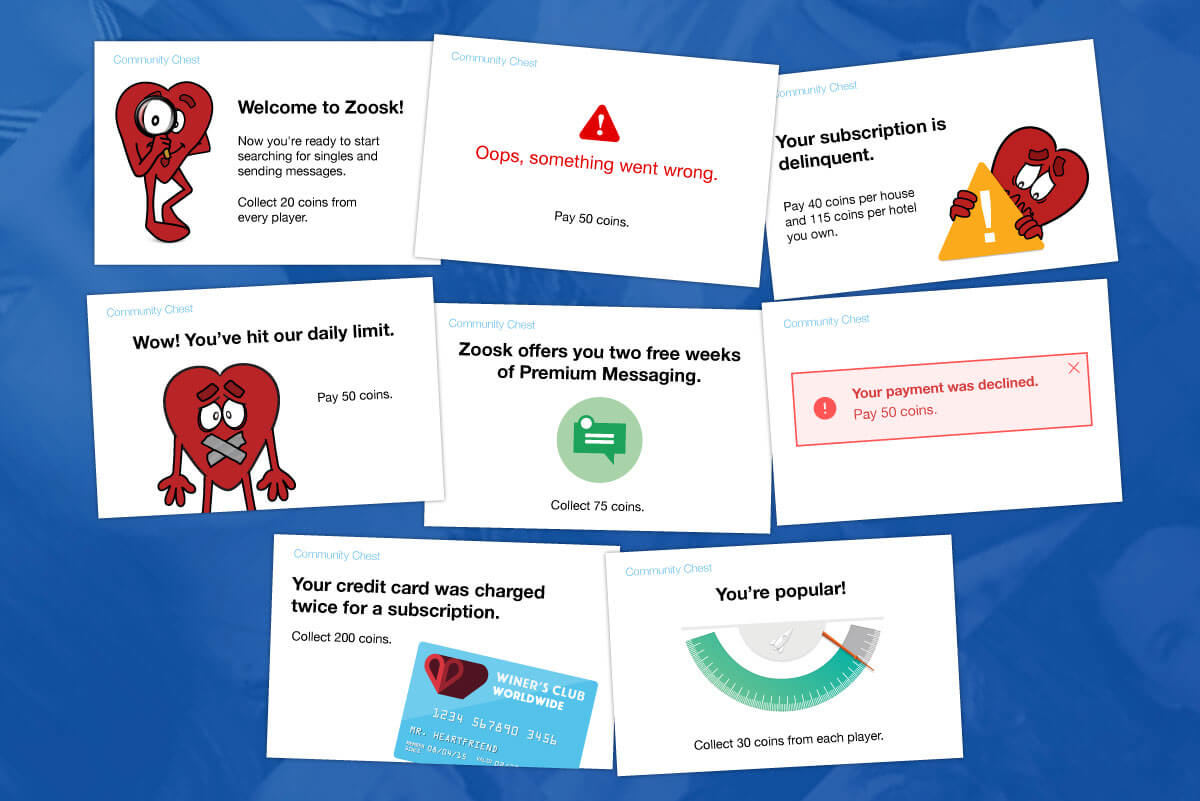
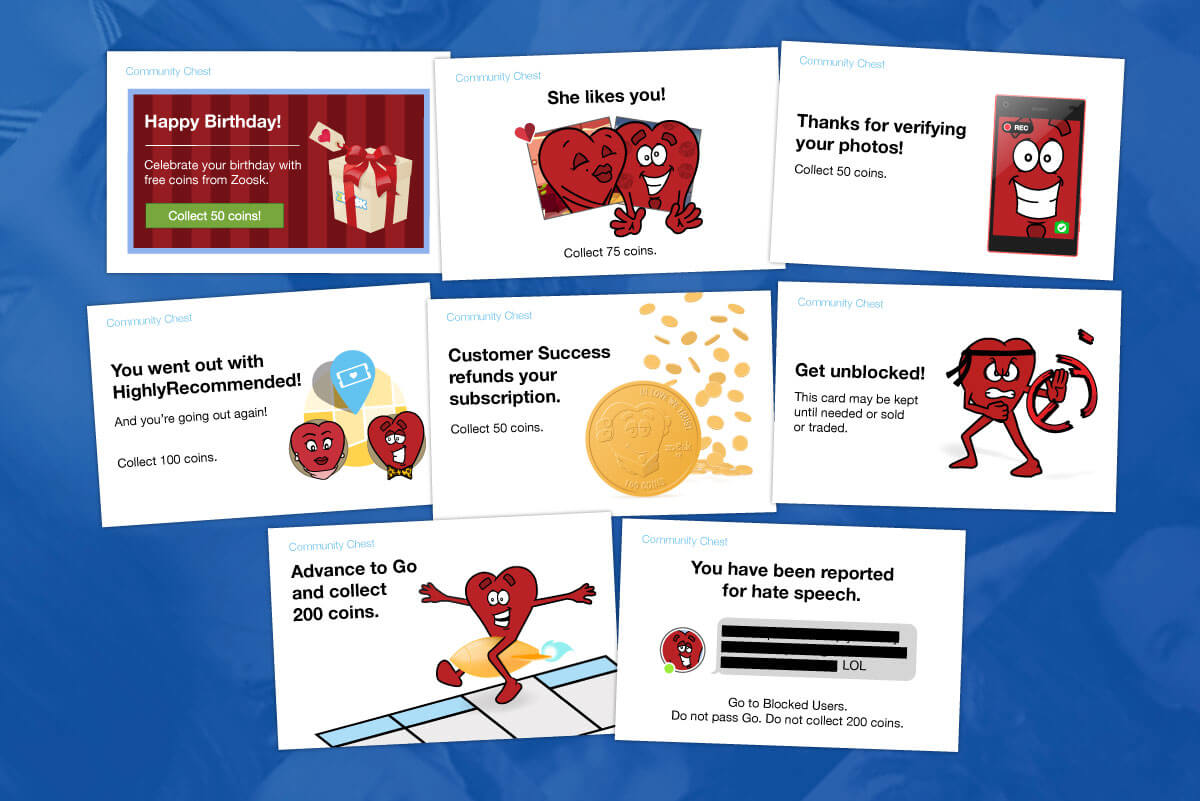
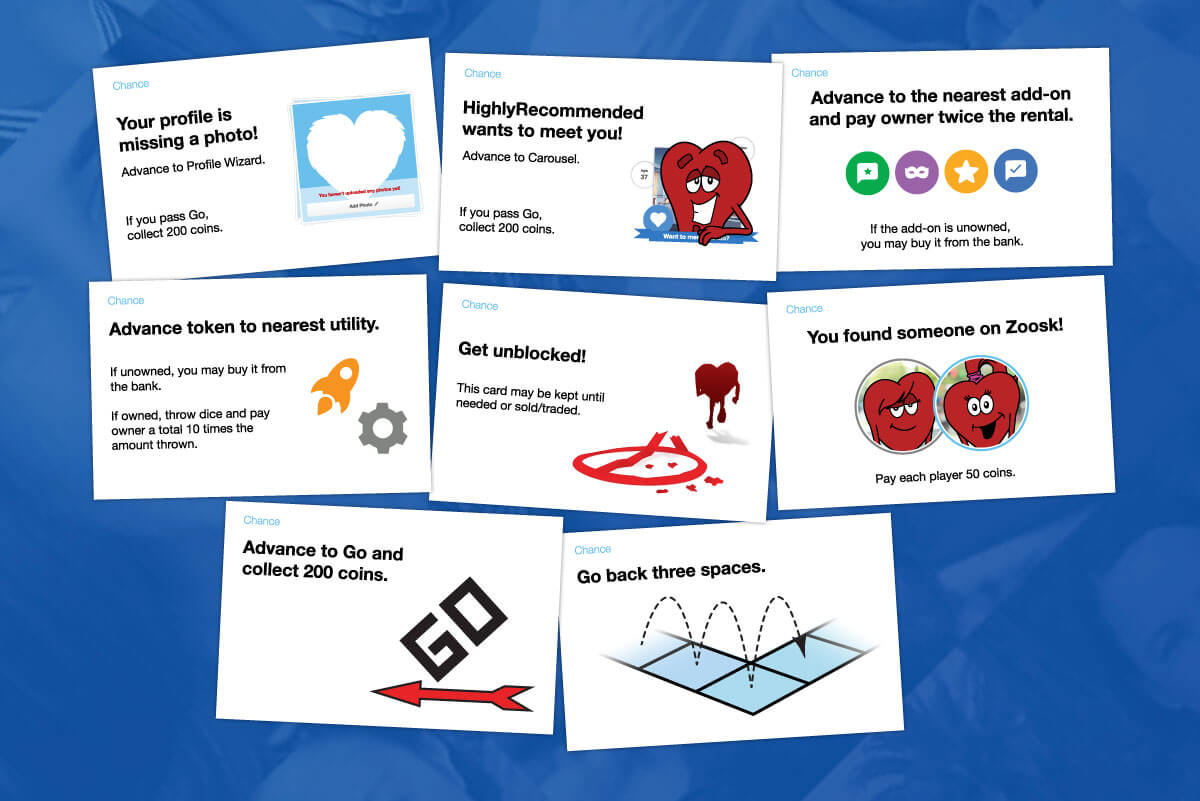
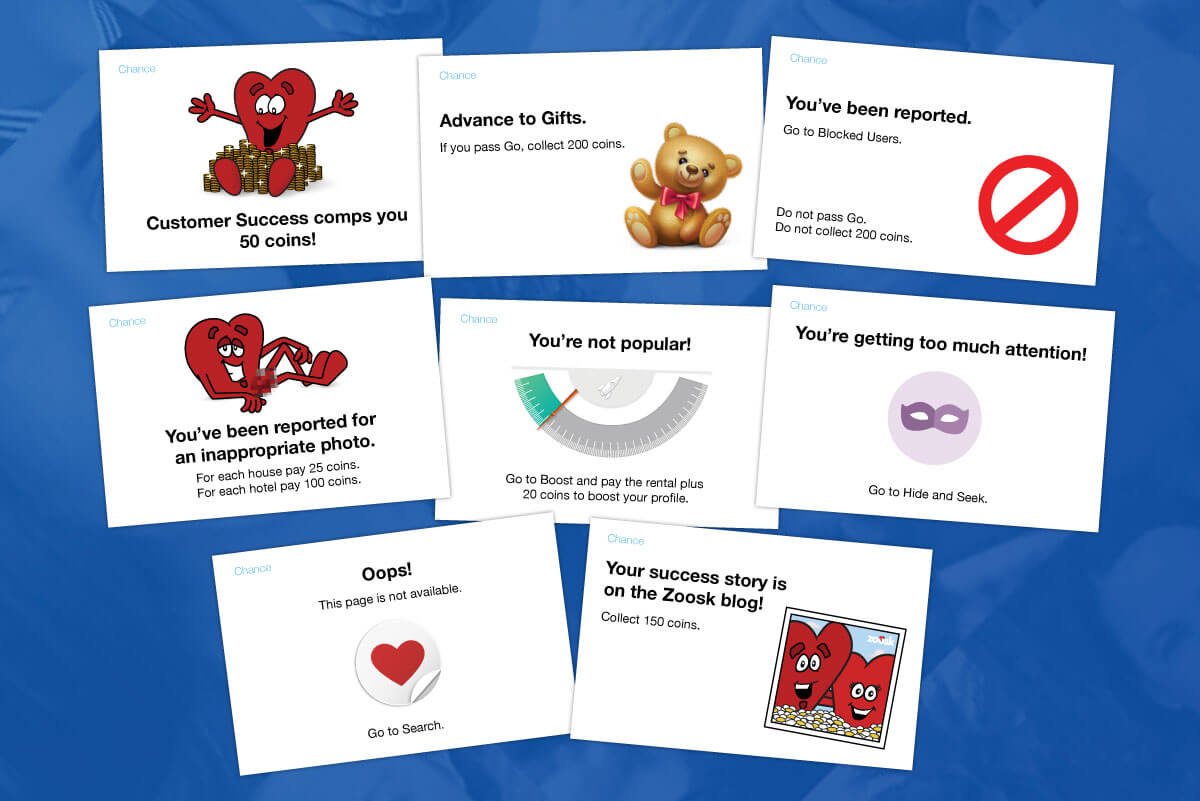
So, should I make game tokens? 😱
At this point the game was only a digital concept. Since I had come so far, I was itching to design game tokens. But I had never used 3D software, and 3D modeling was a different animal.
I found a web-based program called Vectary, which I preferred to use over a desktop app. Luckily Vectary has video tutorials, and with enough practice I got good enough at it.
I used the virtual gifts in Zoosk as models for for the tokens. In the apps you can buy these gifts with coins and send them to other users. I picked the most unique ones for my token designs.

I made two bonus tokens: the rocket used in our Boost feature and a Viking-style hammer. A hammer, you say? Zoosk has a character based on Cupid, and he carries a hammer. He was so out of place that I made the hammer as a joke. I redesigned it, and I must say it's better than the original. Below are the 3D renderings of the tokens in Vectary.

Deed Cards and Those Damn Coins
I also created the deed cards and coins (seven demonimations) in Illustrator.
For the deeds I simply went for a clean design. The only real tie to the Zoosk brand was the use of fonts that appear on the web apps.
The back design, however, screams Zoosk. The product managers at Zoosk loved using modals everywhere in the UI. So the back of the deeds show a modal over the front card design.
For the coins I made up the design for those. They don't look like this in the app.

Should I Turn Pinocchio into a Real Boy?
Well, I decided to pull the trigger on a physical game. I found a game manufacturer called Board Games Maker based in Hong Kong. I was delighted they sell the green houses and red hotels for Monopoly games. Those were the only pieces I decided not to reinvent. Board Games Maker, however, doesn't make custom tokens, so I sent them the other artwork and placed an order.
The cost of my board, cards, etc. wasn't bad: $67 for all the pieces. Because it was coming from China, the shipping was $27. (Ouch!)
But, the turaround was pretty quick, two to three weeks, and overall the pieces came out great. The color on the cards is a bit washed out due to the cardstock, but it's ok. Also the artwork on the coins wasn't centered, but that could have been on my end. It wasn't worth a reorder. Check out Zoosk's Cupid in the Super Send square below.


Some of the Chance and Community Chest cards are inside jokes for Zoosk employees.

Here's the board and all the trimmings.

3D Printing the Tokens
I discovered a 3D printing company called Shapeways out of the Northeast. Their plastic materials seemed affordable enough, but I wanted metal tokens. Their website provides instant quotes when you upload files, and good God—the prices for steel tokens ranged from $15 to $30 each!
Since I had no idea what their quality was like, I ordered two of the cheaper tokens to see if it was worth it: the cocktail and Cupid's hammer.
It took almost a month for them to arrive due to COVID delays, but they looked great! The cocktail drink, however, doesn't have the shiny finish that the hammer has. It couldn't be tumbled and polished because of the delicate features. Sad, because it's not the only token with such characteristics.

Overall, the quality was good, so I ordered the rest of the tokens. Quite a splurge, but they turned out well. (And note that I redesigned the teddy bear. Mine is way cuter.)

Mission Complete
I was very happy and relieved that I got through this project. It was painful, but now I'm very proud of it.
While I was designing this game, Zoosk was bought by another online dating company in Germany. I was sure they were going to shut down our San Francisco office, and my Zoosk family would be no more. I was right, and it was devastating.
So this project inspiration came at the right time. The game captures the hard work our teams (pre-acquisition) poured into our products. And it was a hell of a lot. I have almost eight years of testimony. Others even more.
Zooskopoly (and the apps that inspired it) belongs to us. And it always will, because the new company will eventually change things. That's not our legacy. Zooskopoly is.